 Koolhaas on cows: "Until 1800 real cows grazed on the site of the first Waldorf. A hundred years later, the pressure of popular demand invests the concept of the cow with a technical dimension, producing the inexhaustible Cow on Coney Island, stiff and lifeless, but effective in its production of an endless flow of milk."
In 1935, Elsa Maxwell threw a farmyard party in the Waldorf, complete with Molly the Cow, a cow that milks champagne on one side and whisky and soda on the other. As Koolhaas writes, "Maxwell's farm completes a cycle, the super-refined infrastructure of the hotel, its architectural ingenuity, all its accumulated technologies together ensure that in Manhattan the last word is the same as the first."
Warhol does the same with his cow wallpaper shown at the Leo Castelli Gallery in 1966. Of course the wallpaper covers the gallery, but it also papers, like Christo, the skyscraper (Empire of 1964) and the hotel (Chelsea Girls of 1966). The super-refined infrastructure of Manhattan returns to its pastoral beginnings. The last word is the same as the first. Both Warhol and Manhattan speak with a stutter.
JB
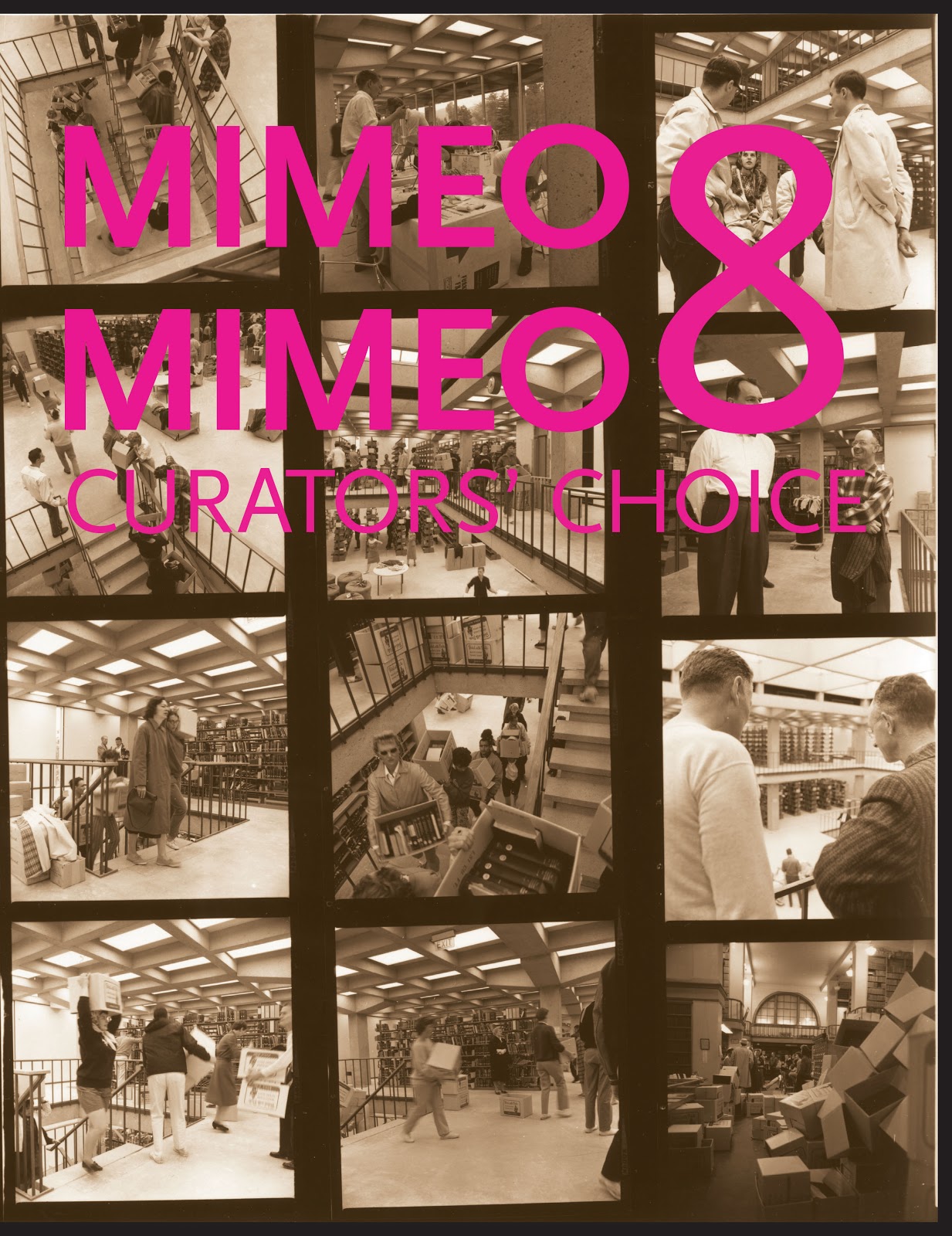 MIMEO MIMEO #8: CURATORS' CHOICE features 16 bibliophiles on 6 highlights from their personal or institutional collections. Contributors include Steve Clay, Wendy Burk, Tony White, Brian Cassidy, Thurston Moore, J.A. Lee, Michelle Strizever, Adam Davis, Michael Basinski, Joseph Newland, Alastair Johnston, Tate Shaw, Michael Kasper, Steve Woodall, Molly Schwartzberg, Nancy Kuhl, James Maynard, and the Utah posse (Becky Thomas, Marnie Powers-Torrey, Craig Dworkin, Emily Tipps, Luise Poulton, & David Wolske)
 MIMEO MIMEO #7: THE LEWIS WARSH ISSUE is the first magazine ever devoted in its entirety to poet, novelist, publisher, teacher, and collage artist Lewis Warsh. Warsh was born in 1944 in the Bronx, co-founded Angel Hair Magazine and Books with Anne Waldman in 1966, and went on to co-found United Artists Magazine and Books with Bernadette Mayer in 1977. He is the author of over thirty books of poetry, fiction and autobiography, the Director of the MFA program in Creative Writing at Long Island University in Brooklyn, and as you’ll soon discover, so much more. Includes an introduction by Daniel Kane, an interview conducted by Steve Clay, 10 new stories, 5 new poems, dozens of photographs and collages, and an anecdotal bibliography.
OUT OF PRINT
MIMEO MIMEO #7: THE LEWIS WARSH ISSUE is the first magazine ever devoted in its entirety to poet, novelist, publisher, teacher, and collage artist Lewis Warsh. Warsh was born in 1944 in the Bronx, co-founded Angel Hair Magazine and Books with Anne Waldman in 1966, and went on to co-found United Artists Magazine and Books with Bernadette Mayer in 1977. He is the author of over thirty books of poetry, fiction and autobiography, the Director of the MFA program in Creative Writing at Long Island University in Brooklyn, and as you’ll soon discover, so much more. Includes an introduction by Daniel Kane, an interview conducted by Steve Clay, 10 new stories, 5 new poems, dozens of photographs and collages, and an anecdotal bibliography.
OUT OF PRINT
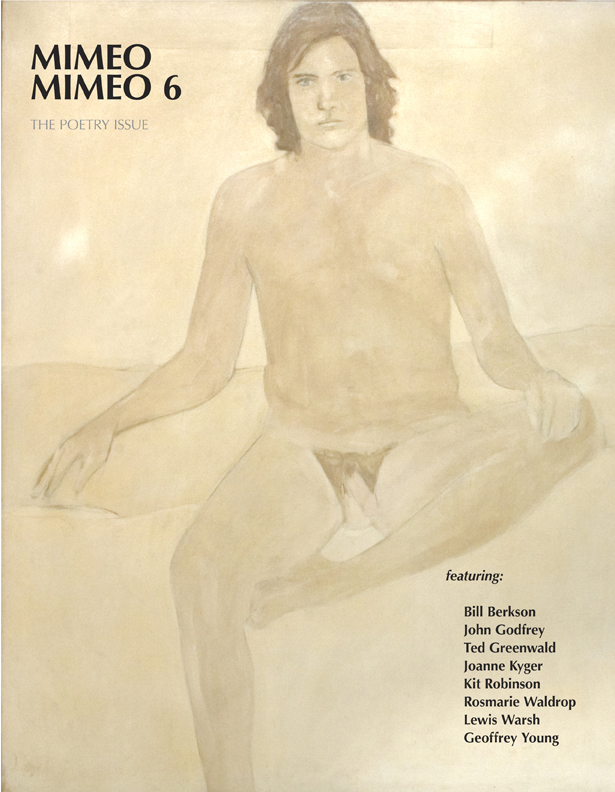 MIMEO MIMEO #6: THE POETRY ISSUE is devoted to new work by eight poets who have consistently composed quality writing that has influenced and inspired generations since the golden era of the mimeo revolution. Contributors include Bill Berkson, John Godfrey, Ted Greenwald, Joanne Kyger, Kit Robinson, Rosmarie Waldrop, Lewis Warsh, and Geoffrey Young. Cover art by George Schneeman.
OUT OF PRINT
MIMEO MIMEO #6: THE POETRY ISSUE is devoted to new work by eight poets who have consistently composed quality writing that has influenced and inspired generations since the golden era of the mimeo revolution. Contributors include Bill Berkson, John Godfrey, Ted Greenwald, Joanne Kyger, Kit Robinson, Rosmarie Waldrop, Lewis Warsh, and Geoffrey Young. Cover art by George Schneeman.
OUT OF PRINT
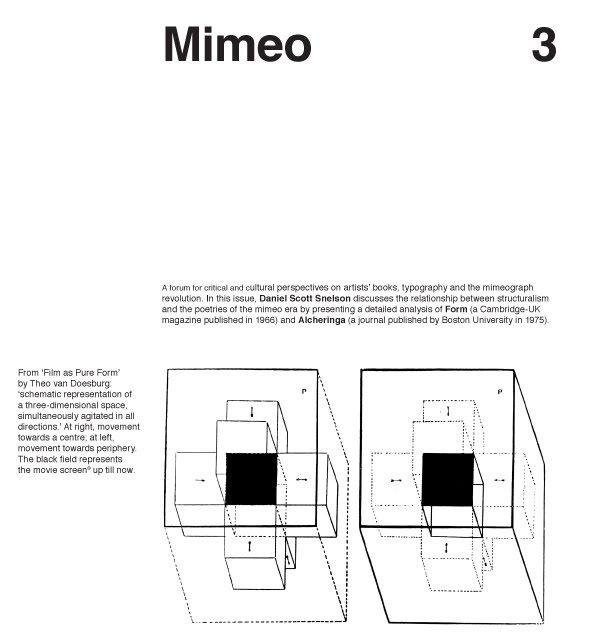 MIMEO MIMEO #3: THE DANNY SNELSON ISSUE examines the relationship between structuralism and the poetries of the mimeo era by presenting a detailed analysis of Form (a Cambridge-UK magazine published in 1966) and Alcheringa (a journal published by Boston University in 1975), two exemplary gatherings that illuminate the historical, material and social circumstances under which theory informed art (and vice versa) in the early works of some of today's most celebrated experimental writers. Also includes a special insert, The Infernal Method, written, designed and printed by Aaron Cohick (NewLights Press).
OUT OF PRINT
MIMEO MIMEO #3: THE DANNY SNELSON ISSUE examines the relationship between structuralism and the poetries of the mimeo era by presenting a detailed analysis of Form (a Cambridge-UK magazine published in 1966) and Alcheringa (a journal published by Boston University in 1975), two exemplary gatherings that illuminate the historical, material and social circumstances under which theory informed art (and vice versa) in the early works of some of today's most celebrated experimental writers. Also includes a special insert, The Infernal Method, written, designed and printed by Aaron Cohick (NewLights Press).
OUT OF PRINT
 MIMEO MIMEO #2: features Emily McVarish on her artist's book Flicker; James Maynard on poet Robert Duncan's early experiences as an editor and typesetter; Derek Beaulieu on the relationship between the influential Canadian poetry journal Tish and Black Mountain College; and an extensive interview with Australian poet and typographer Alan Loney conducted by Kyle Schlesinger. Cover is by Emily McVarish.
OUT OF PRINT
MIMEO MIMEO #2: features Emily McVarish on her artist's book Flicker; James Maynard on poet Robert Duncan's early experiences as an editor and typesetter; Derek Beaulieu on the relationship between the influential Canadian poetry journal Tish and Black Mountain College; and an extensive interview with Australian poet and typographer Alan Loney conducted by Kyle Schlesinger. Cover is by Emily McVarish.
OUT OF PRINT


2 comments:
Hello, today is the photo exhibition day in the world. I have created some wallpapers from good or famous images. I want you to enjoy it and evaluate a comment. For me, here is the list of five wallpapers I've edited:
Blue wallpaper download here
Grey wallpaper download here
Purple wallpaper download here
Orange wallpaper download here
Yellow wallpaper download here
If you want to find other images you like, you can go to this image link:https://colorwallpaper.net/
I really need your comments, these reviews will contribute to the global image.
This is really great site post , Very informative post . Great work bro .
Independent Girls in Mumbai
Post a Comment